Packing paper selection guide
Packing Paper: Wrap, Cushion or Fill? Choose the Right Type
Choose the material by its job and verify the finished parcel, from the first wrap to the final seal.
Choose packing paper by the job it must do: surface wrapping separates finishes, cushioning manages impact, void fill limits movement, and presentation frames the product. These functions can overlap, but a decorative sheet or a handful of shredded paper does not establish protection for a fragile parcel. Evaluate the complete loaded package.
What should packing paper do first?
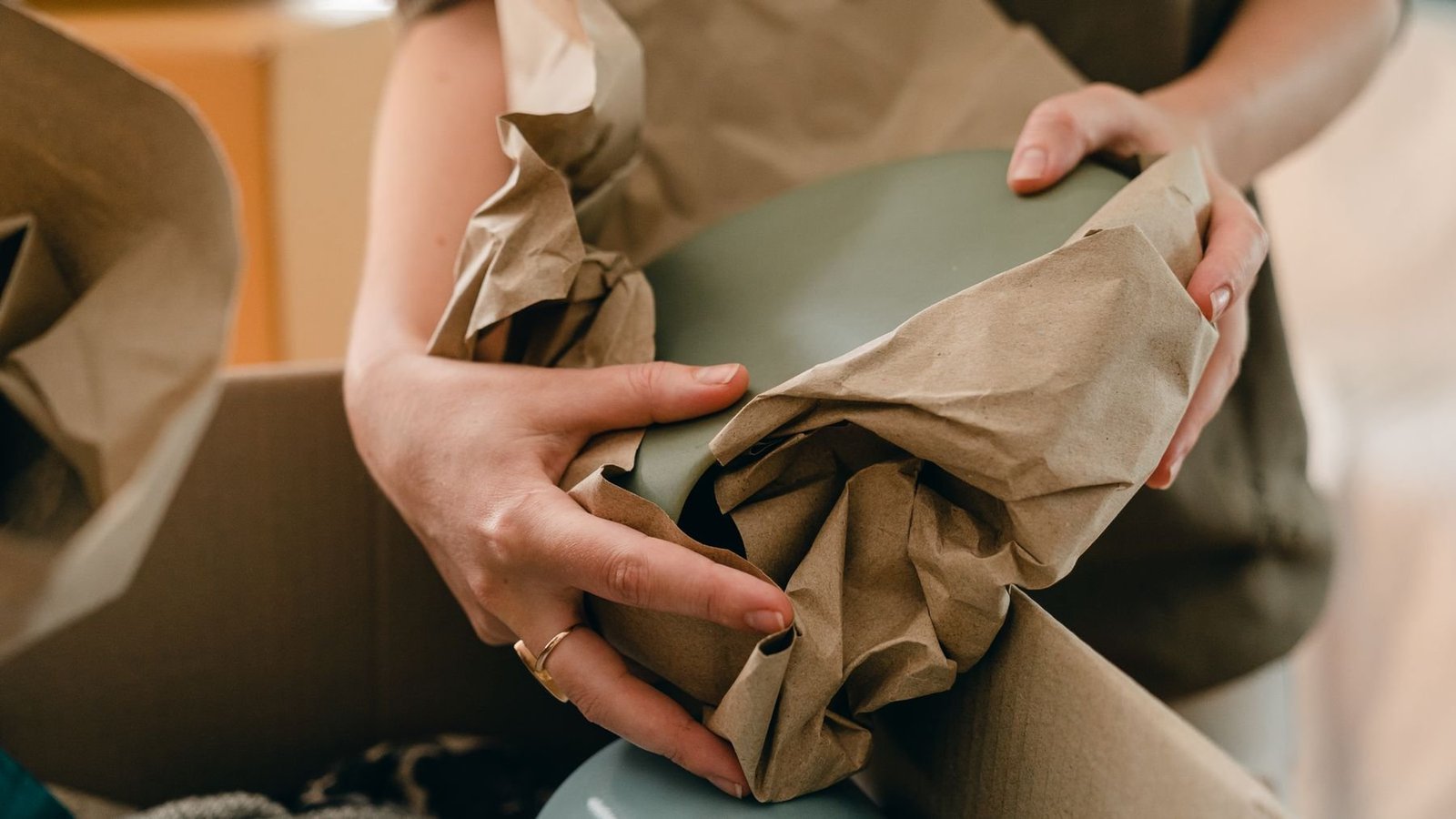
Start with the product and its journey. A household move, a single book order and a ceramic gift set expose packaging to different handling. Record the item dimensions, weight, vulnerable surfaces, fragile areas and delivery route before choosing paper. Then decide which job belongs to each layer.
UPS describes tightly crumpled kraft paper as void fill for lightweight, non-fragile items. That is a narrower role than a promise to cushion every product. Use the carrier guidance for the complete shipment and arrange specialist evaluation when breakage risk warrants it.
For an ecommerce team, the pack must also be repeatable. A method that one experienced packer can execute carefully may work poorly during a busy shift. Compare loading time, paper use, the closed parcel and the condition on arrival. For household packing, label fragile contents clearly and choose the outer carton and protective system around the actual objects.
Four different jobs: wrapping, cushioning, fill and presentation
Surface wrapping separates finishes
A surface layer separates items that could rub together. Blank newsprint, tissue and suitable kraft sheets can be considered for that job. Test the actual material against the finish: texture, dust, color transfer and moisture can matter. Unprinted paper avoids newspaper printing ink, but it is not automatically archival, acid-free or suitable for every surface.
A thin sheet around a jar may separate its label from neighboring objects. It does not demonstrate that the jar will survive a drop. Keep wrapping and cushioning as separate questions in the purchasing brief, even if a proposed material contributes to both.

Cushioning needs a design and a test
Cushioning is intended to manage shock in the product-and-package system. Expanded paper structures can add spacing, but their suitability depends on the object, applied construction and outer package. Density, sharp edges and fragile projections change the design problem. More layers do not automatically produce the right response.
ISTA’s test-procedure overview distinguishes integrity screening from procedures that simulate distribution hazards. Ask a packaging specialist which procedure fits your route and objective. A photograph of a wrapped product or a gentle shake check is not evidence of passing a transport test.
Void fill limits movement inside the carton
Void fill occupies gaps around a suitable inner pack. It must remain effective in the closed package during handling, rather than simply looking full before sealing. Crumpling, compression, settling and the item’s weight affect what happens after packing. Heavy objects may require a locating structure rather than loose decorative material.
If a small item needs a large volume of fill, compare another carton size or a fitted insert. Start with custom shipping boxes sized around the protected contents, then evaluate custom inserts where a defined position is useful. The packaging inserts guide explains how to compare those options.
Presentation creates the opening sequence
Tissue and crinkle paper can frame a gift set and organize the reveal. Treat their appearance as a separate requirement from protection. A branded layer should not cover the shipping label, interfere with the closure, or hide whether the product has moved. Choose the protective system first, then add the presentation layer where it serves the customer.
Which type of packing paper fits each job?
| Material | Role to evaluate | Practical checks | Limitation |
|---|---|---|---|
| Blank newsprint | Surface separation, wrapping and selected light fill | Sheet size, dust, finish compatibility and consumption | Flat sheets do not establish impact cushioning |
| Kraft paper | Crumpled void fill or wrapping suitable sturdy goods | Paper grade, dispensing, crumpling and loaded pack | Brown color does not prove recycled content or strength |
| Honeycomb paper | Expanded wrap and spacing around suitable products | Expansion, overlap, application method and complete parcel | Does not universally replace engineered cushions or inserts |
| Crinkle shredded paper | Gift presentation and selected light fill | Settling, loose fibers, weight per pack and cleanup | Do not assume it protects heavy or fragile goods from impact |
| Tissue | Presentation and gentle surface separation | Print transfer, folds, tears and contact with the product | Not a substitute for validated shock protection |
Compare Stowliva’s hex wrapping paper with dispenser for an expanded-wrap application and EcoComb crinkle shredded paper for presentation or suitable fill. Confirm the proposed use on samples. Product names alone do not establish a tested packout.

Use this decision sequence before buying in bulk
- Identify the risk. Is the object fragile, heavy, sharp, liquid-filled or sensitive to surface contact? Determine any special containment or protective requirements first.
- Choose the outer structure. Fit the carton around the protected product arrangement, with the space the proposed system requires.
- Separate surfaces where needed. Test the wrapping layer against real finishes rather than choosing from appearance.
- Check movement. Compare fill or a locating insert. Inspect the closed pack for obvious shifts without treating this as a formal transport test.
- Add the brand layer. Keep tissue, cards and decorative fill practical to assemble and remove.
- Document the method. Record the materials, amounts, folds, positions, closure and accepted substitutions.
Paper is not automatically waterproof, antistatic or food safe. If one of those properties is required, specify it and request relevant evidence for the finished material and intended use. A general packaging sample should not be approved for a special application solely because it looks similar.
How much packing paper will each order use?
Measure consumption from a consistent packing method. Count sheets, measure unexpanded roll length, or weigh fill according to how the material is supplied. Keep the units clear. An expanded length and a roll length are not interchangeable, and a photograph cannot tell you how many grams of fill a parcel contains.
Planning quantity = material per order × planned orders × (1 + allowance rate). Add an allowance explicitly for the waste and variation you expect, then round to the supplier’s pack size. This is a planning calculation, not a prediction of protection or a guaranteed waste rate.
Here is an invented example for 300 orders with a 12% extra allowance. The amounts are teaching examples, not recommendations for packing a specific product:
| Component | Assumed use per order | Base requirement | With 12% allowance |
|---|---|---|---|
| Blank sheets | 2 sheets | 600 sheets | 672 sheets |
| Paper wrap, measured before expansion | 1.5 feet | 450 feet | 504 feet |
| Presentation fill | 18 grams | 5,400 grams | 6,048 grams, or 6.048 kg |
Compare the full parcel cost as well as paper consumption. FedEx explains dimensional-weight pricing, under which parcel space can affect the billable weight. Measure the outside of the sealed carton and use the rules for your service and contract when comparing sizes. Do not remove necessary protection just to reduce volume.

Run a documented pilot before scaling
Compare at least two candidate methods using representative products and packers. Include the vulnerable variants, rather than selecting only the easiest items. Agree acceptance criteria in advance: product condition, movement, presentation, assembly time, material use and the cost of rework or replacements.
Photograph the packed contents before sealing, measure and weigh the parcel, and identify the packing version. After handling or a representative shipment, inspect the product and every packaging layer. Record what failed and where. A small pilot can reveal problems; its sample size does not by itself establish a reliable damage rate.
When formal evaluation is appropriate, use a documented test plan selected for the product and distribution environment. A design change may require a fresh assessment. Keep material substitutions controlled so that the production package matches the version you approved.
Seven checks to put in the supplier brief
- Function: identify wrapping, cushioning, void fill and presentation separately.
- Compatibility: check roughness, dust, color, odor and product contact.
- Dimensions: state sheet size, roll width, usable wrap length or fill weight, with units.
- Application: evaluate tearing, expanding, crumpling and assembly time at the station.
- Storage: compare the receiving, stockroom and bench space for the supplied format.
- Documentation: request evidence for any claimed properties or fiber sourcing.
- Approval: define the loaded sample, packing instructions, change control and reorder specification.
FSC explains the different meanings of FSC 100%, FSC Mix and FSC Recycled. Confirm documentation and permitted label use for the packaging being ordered. Brown paper color does not establish any of those claims.
For disposal instructions, EPA advises checking what the local recycling program accepts. Evaluate the finished paper, coating, added components and condition after use. Do not assume that flat paper, tissue and shredded fill all have the same collection route.

Keep printed presentation practical
If the brand message sits on tissue, a sleeve or a card, confirm how it looks after folding and loading. Adobe’s bleed guidance explains extending edge-to-edge artwork beyond trim. Follow the printer’s file requirements and approve the assembled result. See Stowliva’s artwork guide and tissue-paper buying guide when planning those components.
Use the Stowliva sample kit to compare materials, then request a packing-paper and box proposal with product dimensions, weight, quantity, destination and intended function. A clear brief makes it easier to compare systems that do the same job and to approve a method the packing team can repeat.
Packing Paper: frequently asked questions
Is packing paper the same as tissue paper?
No. Packing paper is a broad description covering several formats and uses. Tissue is usually evaluated for presentation and gentle surface separation; it does not replace validated shock protection.
Is kraft paper better than crinkle paper?
It depends on the job. Tightly crumpled kraft can be evaluated for void fill around suitable goods, while crinkle is often used for gift presentation and selected light fill. Evaluate the complete loaded package.
Can honeycomb paper replace bubble wrap?
It can be considered as an alternative in some designs, but it is not a universal substitute. Compare the actual product, applied wrap, outer carton and relevant transport performance.
How much packing paper should I buy?
Measure consumption per order using a repeatable method, multiply by planned orders and add an explicit allowance for waste and variation. Keep units clear and round to the supplied pack size.
Is all packing paper recyclable?
Do not assume so. Check the finished material, coatings, contamination, added components and local collection rules. Tissue and shredded paper can have different acceptance requirements from flat sheets.
About this guide: Prepared by Stowliva Editorial using the linked references, reviewed October 18, 2026. Reference photos show independent applications. Confirm specifications for your order.